
Elbert County Probate Court Services
Elbert County Probate Court is part of the combined Probate/Magistrate Court office. The county page names Honorable Stephanie Hewell as the probate judge and chief magistrate. The court's probate jurisdiction includes probate of wills, administration of estates, appointment of guardians, involuntary hospitalizations, issuance of pistol or weapons licenses, and marriage licenses.
Listed local services include marriage licenses and certificates, weapons carry permits, estates and guardianship, and vital records. The court office is associated with 45 Forest Avenue, Elberton, GA 30635. Georgia DPH also lists Elbert County Probate Court as a vital-records office at that address with phone 706-283-2016. The county main office number is 706-283-2000 if a probate-specific line is not posted for a particular service.
Elbert County Probate Court
Judge Stephanie Hewell
45 Forest Avenue
Elberton, GA 30635
706-283-2016
Elbert County Probate Terms
Probate filings use terms that identify the person who died, the person asking the court to act, the person who may manage property, and the protected person in a guardianship or conservatorship. These definitions help match the record type to the correct form or copy request.
- Testator
- A person who made a will before death.
- Executor
- The person named in a will to carry out its terms after appointment by the court.
- Intestate
- A death without a valid will, often requiring administration rather than probate of a will.
- Administrator
- A person appointed to manage an estate when there is no executor acting under a will.
- Guardianship
- A court case involving personal care or decision-making for a minor or protected adult.
- Conservatorship
- A court case involving management of property or finances for a protected person.
Elbert County Probate Record Categories
Probate records are not limited to old wills. Elbert County Probate Court handles several categories that may produce petitions, orders, certificates, letters, inventories, notices, and returns. The correct category affects whether a file can be inspected, which form is used, and whether sensitive information is restricted.
The same office also appears in vital-record and marriage-license workflows. That does not make every vital record a probate estate file. Ask for the service by name, such as marriage certificate, estate record, guardianship file, weapons-carry license matter, or involuntary-hospitalization record, so staff can apply the right access rule and copy process.
| Category | Typical Records | Access Notes |
|---|---|---|
| Wills and estates | Petitions, wills, letters, inventories, appraisals, creditor notices, annual and final returns. | Often searchable through the court office unless sealed or restricted. |
| Administration | Letters of administration and petitions for no-will estates. | Decedent name and estate case number help the search. |
| Guardianship | Petitions and orders for minors or protected adults. | More restricted than ordinary estate files. |
| Conservatorship | Financial authority, inventories, accountings, and orders. | Financial and protected-person information may be limited. |
| Involuntary hospitalization | Mental-health probate proceedings. | Sensitive and generally not treated as open public files. |
| Marriage and vital records | Marriage licenses, certificates, and local vital-record services. | Use the Probate Court or DPH channel depending on the record. |
Georgia Probate Standard Forms
Georgia probate filings use statewide standard forms approved through the state court system. The Supreme Court of Georgia probate standard forms page lists general instructions and forms such as GPCSF 1, GPCSF 2 for temporary letters of administration, GPCSF 3 for letters of administration, GPCSF 4 to probate a will in common form, and GPCSF 5 to probate a will in solemn form.
Additional forms cover administration, guardianship, conservatorship, year's support, and related probate matters. The Elbert County Probate/Magistrate page links users to Georgia court forms and additional information, so a person filing locally should read the statewide instructions and then confirm local filing requirements with Probate Court at 45 Forest Avenue.
The Georgia probate standard forms source is the official form-list channel assigned to this page.
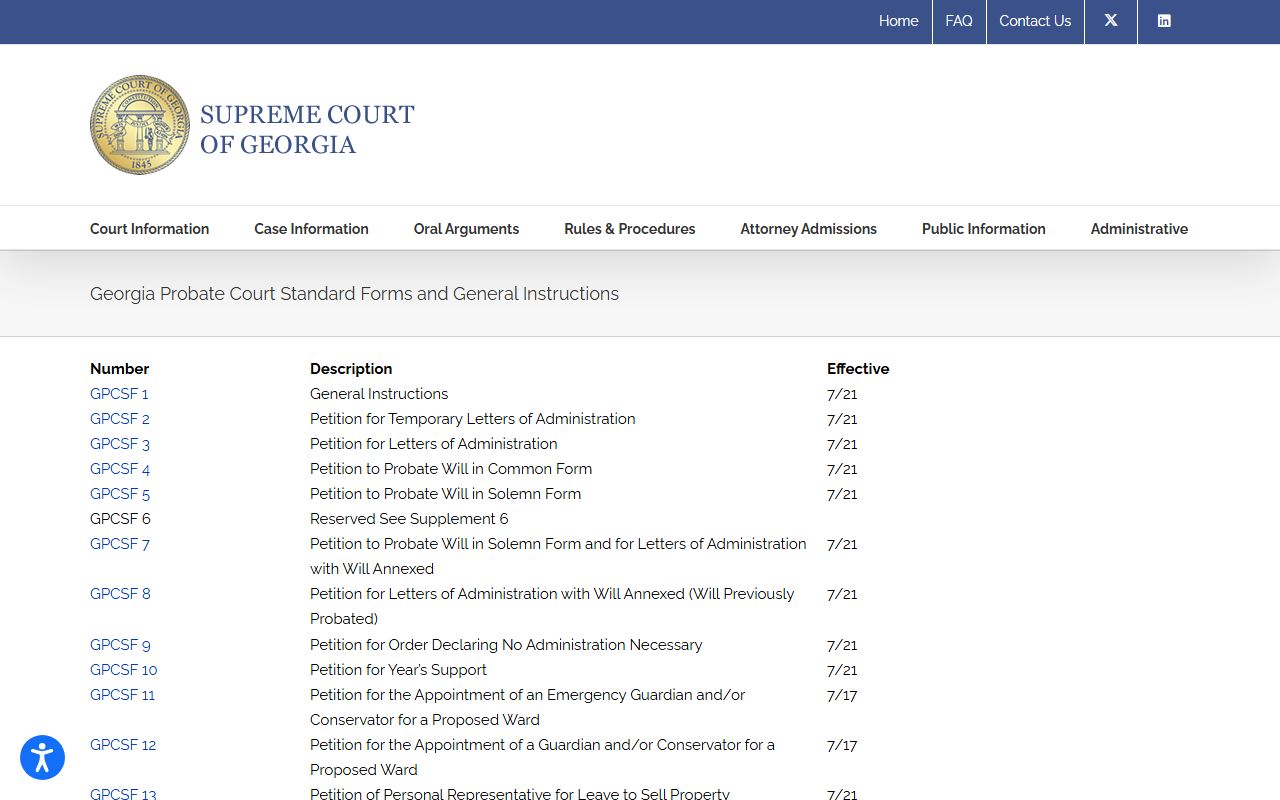
Use the standard forms as the filing starting point, then use Elbert County Probate Court for local filing, fee, and copy instructions.
Search Elbert County Probate Records
The research did not locate a county-run public online probate case-search portal for Elbert County. The practical access chain is the local Probate Court office, phone confirmation, in-person inspection or copy request, and mail or certified-copy instructions provided by the court. For filing forms, use Georgia Probate Court Standard Forms. For vital-record requests tied to marriage or local vital records, use Probate Court or Georgia DPH as appropriate.
- Identify the probate category: will, estate administration, guardianship, conservatorship, marriage/vital record, weapons carry, or involuntary hospitalization.
- Gather the decedent name, estate case number, petitioner name, approximate filing date, or protected-person details if you are authorized to request them.
- Contact Elbert County Probate Court at 45 Forest Avenue or 706-283-2016 to confirm access, copy procedure, and current fee.
- Use Georgia Probate Court Standard Forms if a new filing or petition is needed.
- Request certified copies through the Probate Court office and follow the court's mailing or pickup instructions.
What Elbert Probate Records Show
Probate record fields depend on the case type. Estate files often focus on the decedent, heirs, beneficiaries, petitioner, executor, administrator, and property. Guardianship and conservatorship matters focus on the protected person, proposed guardian or conservator, orders, and accounting duties. Some inventories, returns, and medical or financial details may be redacted or restricted.
| Field or Record Item | Type | Public Access Notes |
|---|---|---|
| Decedent name | Estate field | Usually needed to search estate records. |
| Estate case number | Court field | Use if known from a notice, filing, or copy. |
| Petition type | Form or document | May identify letters of administration, probate will common form, probate will solemn form, guardianship, or conservatorship. |
| Petitioner, administrator, or executor | Party field | Usually visible in estate dockets unless sealed or restricted. |
| Heirs or beneficiaries | Party field | May appear in petitions or notices; sensitive details may be redacted. |
| Inventory or returns | Financial document | Access may depend on case type and court rules. |
| Guardianship or conservatorship | Protected-person matter | More restricted than ordinary estate records. |
| Involuntary hospitalization | Mental-health matter | Sensitive and restricted. |
Elbert County Probate Fees
The research file did not locate an official Elbert County Probate Court fee schedule for estate filings, letters, certified copies, guardianship petitions, or conservatorship petitions. That gap should be handled by contacting Probate Court before filing or mailing a copy request. Georgia DPH fees may apply to state vital-record requests, but those fees do not cover every probate file or estate document.
| Item | Amount or Status |
|---|---|
| Original probate filing | Local fee not located in official research sources. |
| Letters testamentary or letters of administration | Local fee not located in official research sources. |
| Certified probate copy | Local fee not located in official research sources. |
| Guardianship or conservatorship petition | Local fee not located in official research sources. |
| Georgia DPH marriage search and certified letter | $10, plus $5 for each additional copy ordered at the same time. |
Restricted Elbert Probate Records
Not every Probate Court file is an ordinary public record. Guardianship, conservatorship, minor, mental-health, involuntary-hospitalization, sealed, and redacted files may have access limits. A public file may still withhold Social Security numbers, financial account numbers, medical information, protected addresses, minor names, and other sensitive details.
Georgia court records are generally public unless access is limited by law or court order, but probate access depends heavily on the record type. Estate records may be available at the counter, while protected-person matters may require party status, attorney authority, agency authority, or a court order. When the online form list does not answer a records question, contact Elbert County Probate Court rather than assuming the file is unavailable.
Estate administration also creates records over time. A new filing may begin with a petition to probate a will or a petition for letters of administration, then later add creditor notices, inventory, accounting, returns, year's support, or final distribution papers. If a search is tied to property, heirs, or title work, ask whether the court file has later returns or orders beyond the first petition.
Guardianship and conservatorship records need a narrower request. The public may be able to confirm that a case exists in some circumstances, but medical, financial, protected-person, and minor details can be limited. For that reason, party status, attorney authority, agency role, or a judge's order may matter more than the fact that the file is held by Probate Court.
The Georgia Courts JDEX attorney verification page illustrates that some court-information systems limit access to authorized users when confidential records are involved.
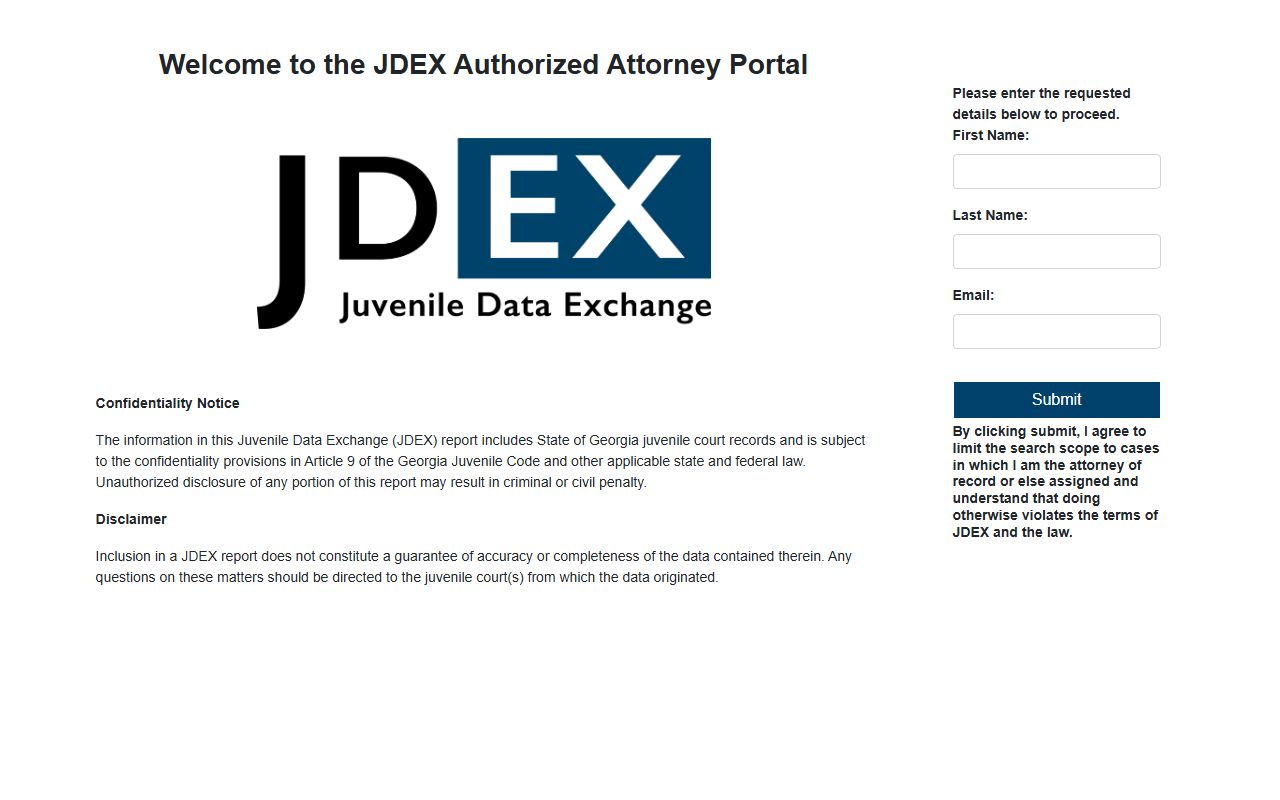
That access model is a useful reminder that protected court records can exist even when the public cannot retrieve the full file online.