
Elbert County Criminal Court Records
Criminal court records are the case-level records maintained after a charge becomes part of a court proceeding. In Elbert County, felony criminal cases belong to Superior Court. State Court handles many misdemeanors and traffic-related misdemeanors. Magistrate Court is important for warrants, first appearances, bond, and preliminary hearings. Elberton Municipal Court handles adult city traffic and ordinance cases inside the city limits. The Clerk of Court records Superior, State, and Juvenile Court proceedings at the county courthouse.
The full criminal case file is broader than an arrest record. It may include a charging document, docket entries, bond activity, arraignment, plea, motions, hearing notices, orders, verdict, disposition, sentence, probation terms, and certified disposition. For a closer look at the charge list and arrest-to-charge path, use the Elbert County arrest records and charges page. For civil, probate, land, and other case files, use the broader Elbert County court records page.
The manifest image from the Northern Judicial Circuit District Attorney contact page documents the prosecutor office that serves Elbert County criminal court records.
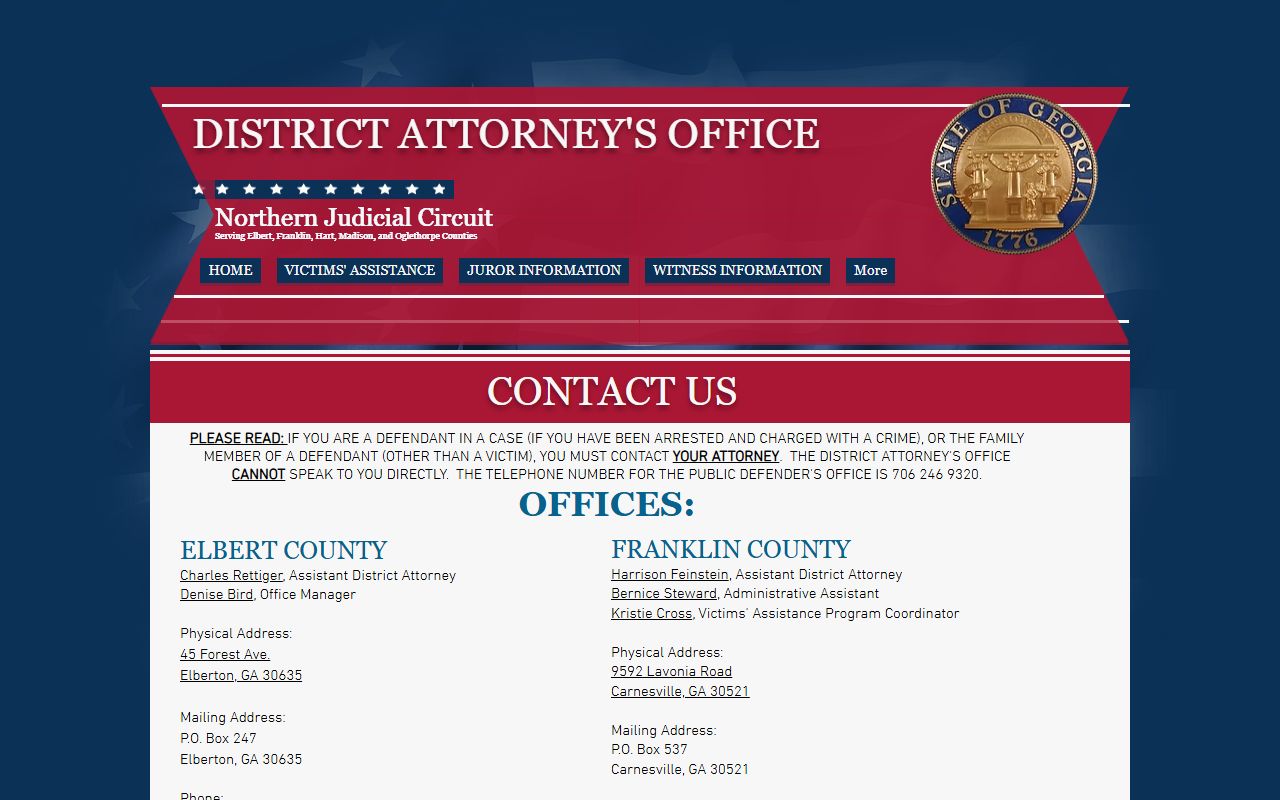
That office is a key criminal-case contact, but certified dispositions come from the clerk in the county where the charge was filed.
Search Elbert County Criminal Records
There is no single Elbert County-owned public criminal case portal that replaces the Clerk of Court. For Superior and State Court criminal matters, start with the Clerk of Court or search re:SearchGA if the case and court are available in that system. PeachCourt and Odyssey eFileGA may support e-filing workflows, but they are not complete no-login public criminal docket indexes. Municipal traffic and ordinance cases remain with Elberton Municipal Court, and federal criminal records are searched through PACER.
Use a defendant's full legal name, case number, citation number, warrant number, or filing year when available. A criminal court record may show multiple charges, and each charge can have its own status. Public access also varies. Juvenile cases, sealed files, restricted criminal history, active investigative material, and sensitive personal data may be withheld or redacted.
- Identify the court: Superior for felonies, State for many misdemeanors, Municipal for Elberton city cases, or Magistrate for warrant and first-appearance functions.
- Search by case number when known, then by full defendant name if the case number is not available.
- Review the docket for charges, arraignment, motions, hearings, plea, disposition, and sentence entries.
- Contact the Clerk of Court when the online result is incomplete or a certified disposition is required.
- Use prosecutor, public defender, or sheriff contacts for current-case questions that are not answered by the court record.
Elbert County Criminal Case Flow
A criminal court record grows as the case moves through court. The first court event may follow an arrest, citation, warrant, accusation, or indictment. Magistrate Court may be involved early for warrants, bond, first appearances, and preliminary hearings. Superior Court carries felony prosecution. State Court and Municipal Court carry many misdemeanor, traffic, and ordinance matters. The docket should be read as a sequence, not as a single charge line.
Case flow: Charges Filed › Arraignment › Pretrial / Motions › Plea or Trial › Disposition › Sentencing
| Stage | What Happens |
|---|---|
| Charges Filed | An accusation, indictment, citation, or other charging paper places the allegation into the court case. |
| Arraignment | The defendant is formally advised of charges and enters a plea such as guilty, not guilty, or nolo contendere. |
| Pretrial / Motions | Attorneys file requests, seek rulings, address evidence, ask for continuances, or prepare for plea or trial. |
| Plea or Trial | The case resolves by plea, bench trial, jury trial, dismissal, nolle prosequi, or another court action. |
| Disposition | The court records the result for each charge, including guilty, not guilty, dismissed, dead docket, or nolle prosequi. |
| Sentencing | A sentence may include jail, prison, probation, fines, costs, restitution, conditions, or other court orders. |
Elbert County Criminal Record Fields
A criminal court record should be read field by field. The case number identifies the file. The court name shows the venue. Party fields identify the State and the defendant. Docket entries show the order of filings and hearings. The disposition and sentence fields show the outcome, but they should be checked against the final judgment or certified disposition when legal proof is needed.
| Field | What It Shows |
|---|---|
| Case Number | The court-assigned identifier used for docket lookup and copy requests. |
| Defendant | The person charged in the criminal case. |
| Court Name | Superior, State, Magistrate, Municipal, or federal court depending on the case route. |
| Charges | Felony, misdemeanor, traffic, ordinance, accusation, indictment, or citation counts as filed. |
| Bond | Bond amount, bond type, or release conditions when recorded in the court file. |
| Plea | Guilty, not guilty, nolo contendere, or another formal response to the charge. |
| Motions and Orders | Attorney requests and judge rulings filed during the case. |
| Disposition | The current or final result of each count, such as guilty, dismissed, dead docket, or nolle prosequi. |
| Sentence | Jail, prison, probation, fines, costs, restitution, conditions, or court-ordered supervision. |
| Restrictions | Sealing, juvenile status, redaction, or Georgia record restriction when applicable. |
Charges vs Convictions
A charge is an allegation filed into a criminal case. A conviction is an outcome after a guilty plea, guilty verdict, or other qualifying adjudication. Elbert County criminal court records can show charges that were amended, reduced, dismissed, nolle prossed, placed on the dead docket, or resolved differently from the first charge list. Do not treat every filed charge as a conviction.
| Charge | Conviction | |
|---|---|---|
| Stage | Filed at the start or during prosecution. | Recorded after plea, verdict, or qualifying adjudication. |
| Meaning | An accusation that must still be proved or resolved. | A court outcome tied to guilt or legal responsibility. |
| Record risk | May appear even if later dismissed or reduced. | May affect sentence, probation, restriction eligibility, and criminal-history reporting. |
| Proof | Read the charge and later docket entries together. | Use the final disposition or certified court copy. |
Read Elbert Criminal Dispositions
Disposition is the result field. Guilty means the case ended in a guilty plea or finding. Not guilty means the charge was not proved at trial. Dismissed means the charge was ended by court action. Nolle prosequi means the prosecutor chose not to proceed. Dead docket means the case is inactive but not an acquittal. Probation is court-ordered supervision. Restitution is repayment ordered to compensate a victim.
The Northern Judicial Circuit District Attorney FAQ provides several practical record points. It says defendants and family members should contact their attorney rather than speak directly with the DA. It also says address changes after arrest should be made at the DA's Office with picture ID and also provided to the Clerk of Court, the bond signer, and the attorney. Certified copies of court dispositions come from the Clerk of Superior Court in the county where the person was charged.
Northern Judicial Circuit District Attorney
Elbert County Office
45 Forest Ave.
Elberton, GA 30635
Mail: P.O. Box 247, Elberton, GA 30635
706-283-1716
Fax: 706-283-1907
Elbert County Defense and Custody
The criminal court record does not replace legal counsel or custody checks. The Northern Judicial Circuit Public Defender's Office is listed in the DA FAQ at 461 Cook St, Royston, GA 30662, phone 706-246-9320. The Georgia Public Defender Council find-defender page is the statewide lookup source, while the DA FAQ gives the local circuit contact block found in research.
The Sheriff's Office operates arrest, booking, bond, court transport, and detention functions that may lead into a criminal court case. The detention division processes people taken into custody, handles bonds, schedules court transports, submits fingerprints, prepares inmate records for court, and schedules inmate-attorney consultations. The court record tracks the case result. The jail record tracks custody status.
The manifest image from the Georgia Public Defender Council office lookup documents the statewide public-defender access channel for Elbert County criminal court records users.
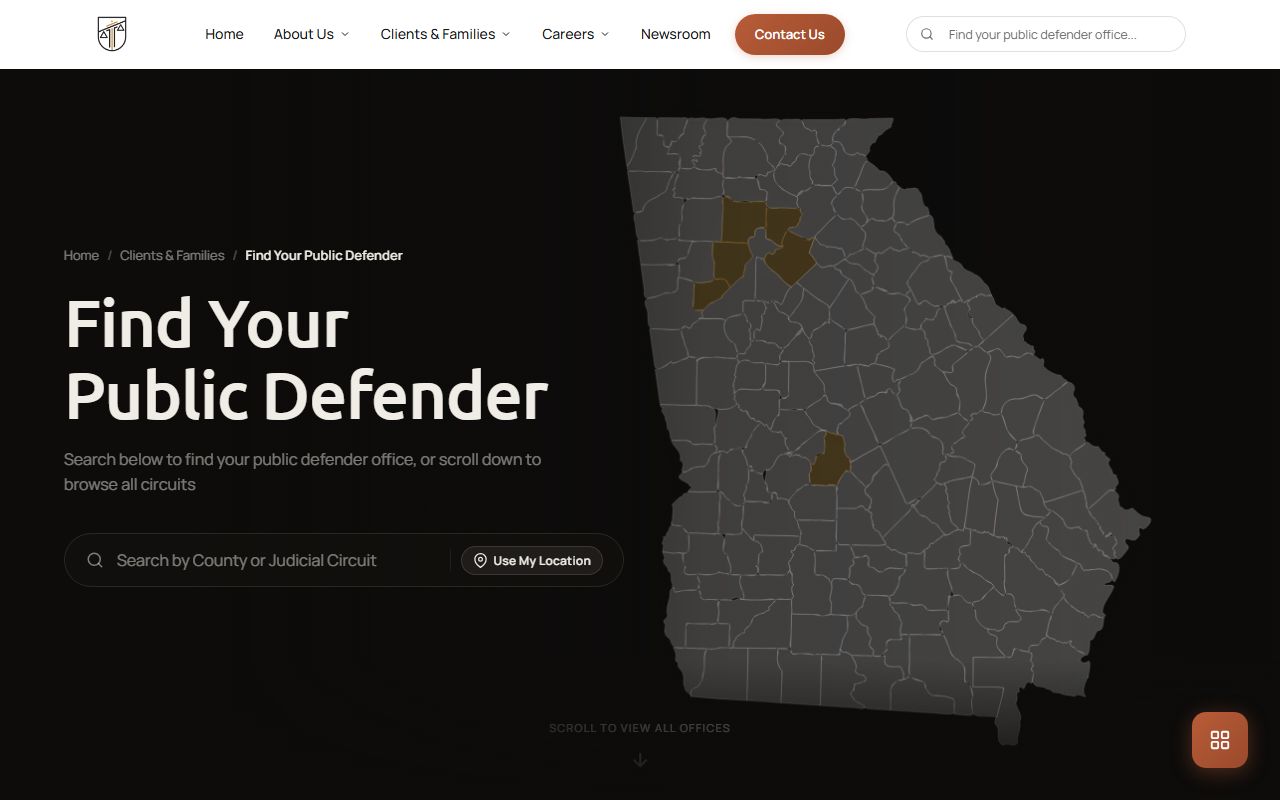
Use that lookup with the local circuit contact details when a criminal court record reflects appointed-counsel issues.
Sealed vs Restricted Records
Georgia commonly uses record restriction rather than the word expungement for limiting eligible criminal-history information. O.C.G.A. 35-3-37 and the GBI record restriction page explain that eligible Georgia criminal-history records may be restricted for non-criminal-justice purposes after prosecutor approval or court order. Court-file sealing can require a separate court order under court rules.
| Sealed Court File | Restricted Criminal History | |
|---|---|---|
| What changes | Public access to a court file or document is limited by law or order. | Eligible criminal-history information is limited for non-criminal-justice purposes. |
| Who handles it | The court where the file or document exists. | GBI, prosecutor, arresting agency, or court depending on date and case type. |
| What remains | Some docket data may still appear if not sealed. | Jail, court, news, or driver-record consequences may need separate review. |
| Elbert route | Confirm with the Clerk of Court for Superior or State Court files. | Confirm eligibility with the prosecutor, clerk, or arresting agency. |
The manifest image from the GBI criminal-history record restriction page shows the official state channel for Georgia restriction rules.
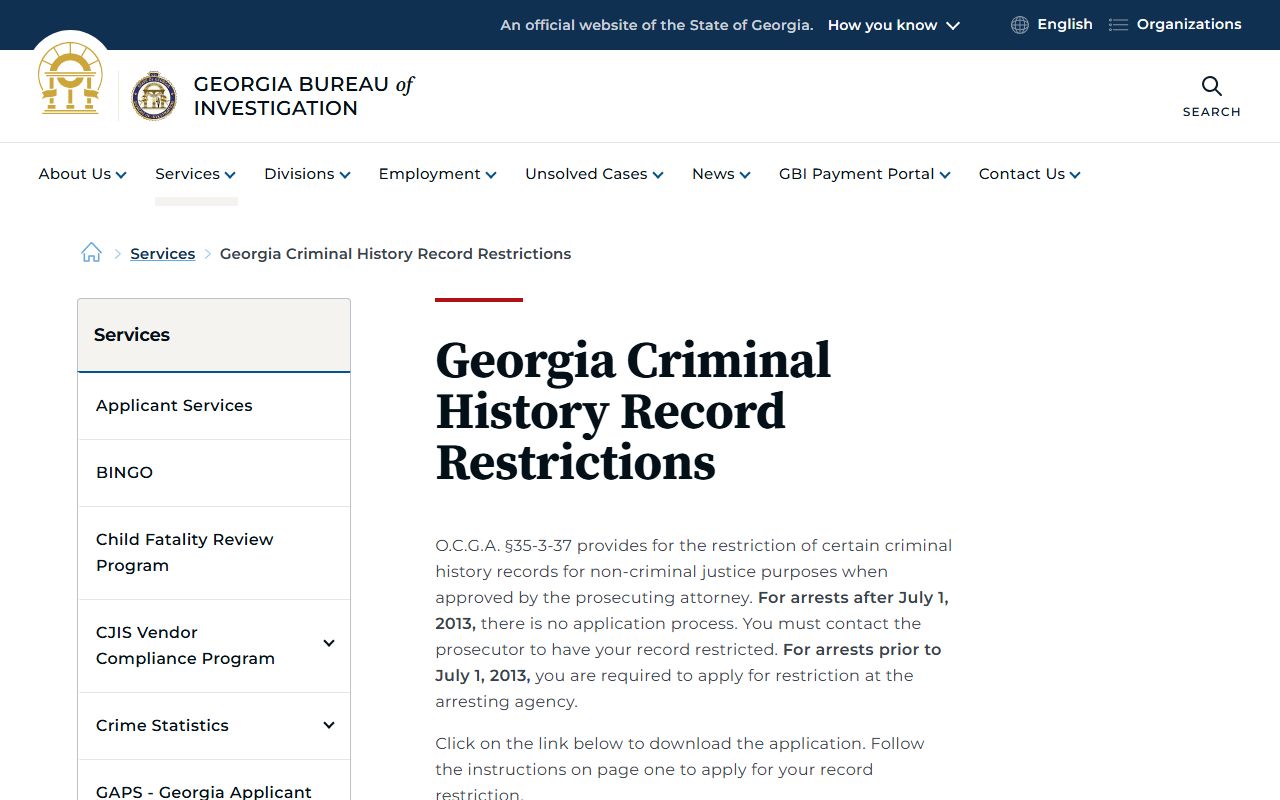
Restriction can affect criminal-history visibility, but it should not be described as automatic removal of every Elbert County court record.
Public Access to Elbert Criminal Records
Adult criminal court records are generally public unless a statute, court rule, redaction rule, or order limits access. Georgia's Open Records Act, including O.C.G.A. 50-18-70 and O.C.G.A. 50-18-71, applies to public records but does not override every court-specific or privacy rule. Uniform Superior Court Rule 21 addresses procedures for limiting access to court files.
Juvenile criminal-type matters are different. Georgia Juvenile Code provisions, including O.C.G.A. 15-11-700 through 15-11-710 as referenced in the research, make juvenile records more confidential than adult files. Protected victim information, minor names, Social Security numbers, financial account numbers, medical details, mental-health records, adoption records, and sealed documents may be redacted or withheld. A public search result is not a guarantee that every document in the file can be viewed.
Note: Public criminal case access does not make juvenile, sealed, restricted, or redacted information open to general inspection.
Federal Elbert Criminal Records
Federal criminal records involving Elbert County are outside the county clerk's case system. Elbert County is in the Athens Division of the U.S. District Court for the Middle District of Georgia. Federal docket and document access uses PACER and the PACER Case Locator. Appeals from the Middle District go to the U.S. Court of Appeals for the Eleventh Circuit.
The U.S. Attorney's Office for the Middle District of Georgia handles federal criminal and civil enforcement for the district. The U.S. Marshals Service Middle District of Georgia handles federal detainee, fugitive, courthouse-security, and prisoner-transport functions. County criminal court records and federal criminal records should be searched through their separate custodians.
The manifest image from the U.S. Attorney's Office for the Middle District of Georgia documents the federal prosecution channel tied to Elbert County's federal venue.
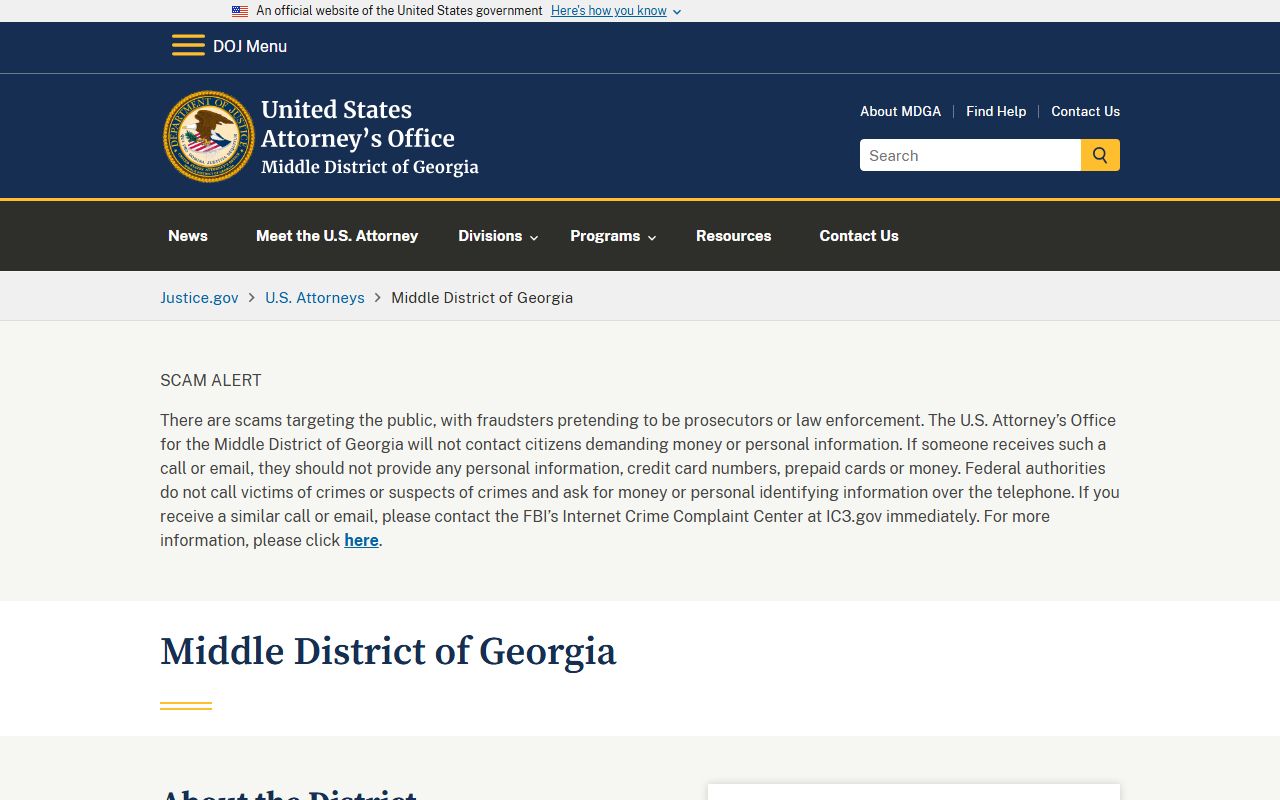
Use federal court systems for federal indictments or prosecutions, and use the Elbert County clerk for local Superior and State Court criminal files.