
Elbert County Arrest Records and Court Charges
Arrest records in Elbert County begin with the law-enforcement event: an officer takes a person into custody, the Detention Center receives and processes the person, and jail staff prepare inmate records for court. The Elbert County Sheriff's Office lists patrol duties that include serving warrants, making arrests, transporting offenders, preparing reports, and responding to emergency and non-emergency calls. Its Detention Center then handles booking, bond processing, court transports, fingerprints, and inmate court records.
Court charge records begin after that first custody step. A prosecutor decides which formal charges to file, and those charges become part of the case record. In Elbert County, felony prosecutions are handled in Superior Court, while State Court and Municipal Court may handle misdemeanor, traffic, and ordinance matters. Magistrate Court can be important for warrants, first appearances, bond, and preliminary hearings. For the jail custody view, use the Elbert County inmate records page. For the full case file, plea, disposition, and sentence, use the criminal court record.
The sheriff homepage is the local starting point for arrest and detention contacts that feed into Elbert County arrest records.
Find Elbert County Arrest Records
There is no single researched source that combines every booking detail, prosecutor decision, and final criminal disposition into one public screen. Use the source that matches the question. For custody status and a current local hold, start with the county inmate locator or the sheriff. For filed criminal charges, case status, and certified dispositions, contact the court or Clerk of Court for the case. For a warrant tied to the arrest, confirm the issuing court or sheriff channel.
- Check the official Elbert County inmate locator linked from the sheriff site if the person may still be in county custody.
- Call the Sheriff's Office at 706-283-2421 if the online listing is missing, stale, or unclear.
- Use the case number, citation number, warrant number, or defendant name to ask the court clerk about filed charges.
- Read each charge separately because one arrest can produce several charge counts with different statuses.
- Request a certified disposition from the Clerk of Superior Court in the county where the person was charged when proof of outcome is needed.
Georgia public-access rules start with the office that created or maintains the record. Booking and incident records go through the sheriff, while Superior, State, and Juvenile Court filings go through the Clerk of Court. Probate, Magistrate, and Municipal Court records may require separate contact depending on the source of the charge.
Charges After Arrest
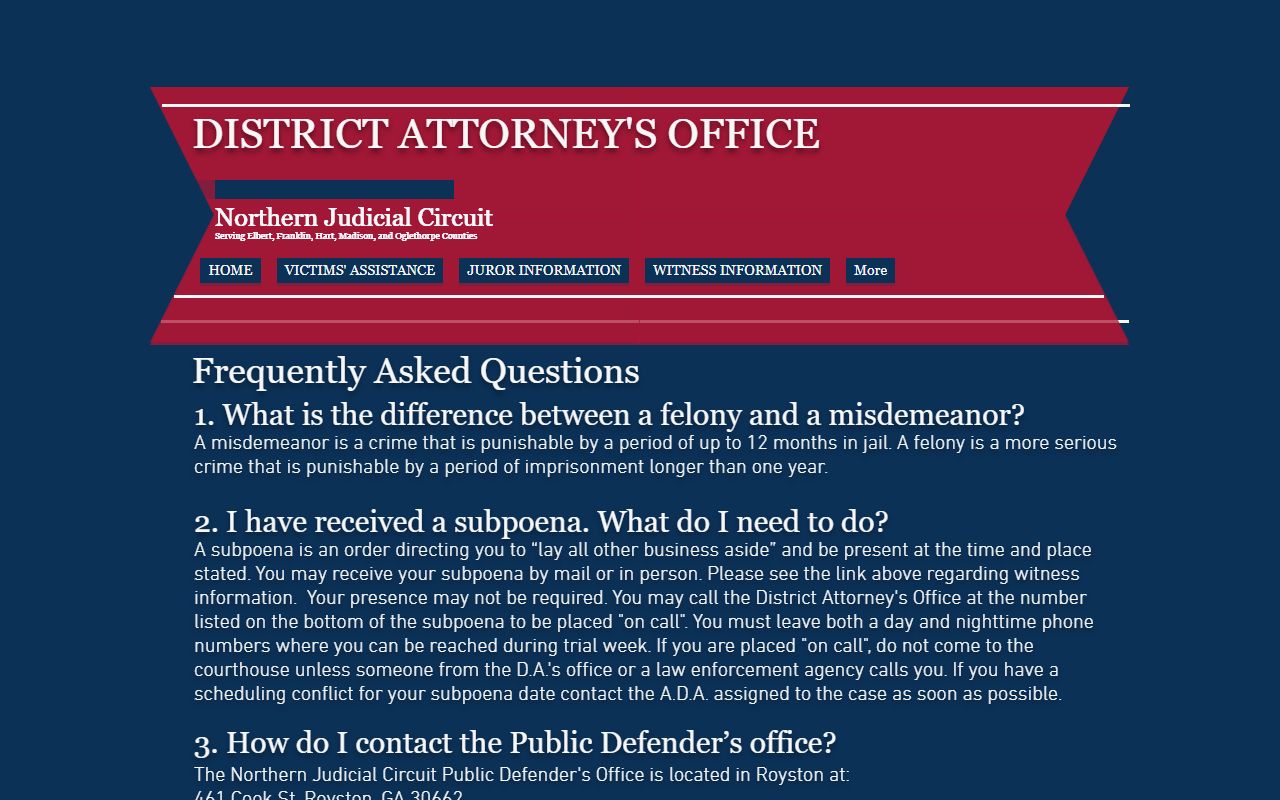
The arresting officer does not make the final prosecution decision. The Northern Judicial Circuit District Attorney's Office serves Elbert, Franklin, Hart, Madison, and Oglethorpe counties. Its Elbert County office is listed at 45 Forest Ave., Elberton, GA 30635, with mailing address P.O. Box 247, Elberton, GA 30635, phone 706-283-1716. The DA FAQ says a victim may speak to the assistant district attorney about dropping charges, but the DA decides whether prosecution continues in the State of Georgia's interest.
The same DA FAQ gives practical record guidance. It says defendants and family members cannot speak directly with the DA when represented by counsel and should contact the attorney. It also says address changes after arrest should be made at the DA's Office with picture ID and also provided to the Clerk of Court, the bond signer, and the attorney. That warning matters because missed notices can lead to court problems after the arrest date.
The Northern Judicial Circuit District Attorney FAQ explains why prosecutors, not victims or arresting officers alone, decide how charges proceed.
Elbert County Charging Documents
A charging document is the formal paper that starts or defines the accusation in court. The research identifies accusations, indictments, citations, warrants, complaints, and related filings as records that may appear in sheriff, Magistrate, Municipal, State, or Superior Court workflows. The exact document depends on the court, the charge level, and the stage of prosecution.
| Document | Who Uses It | What It Means in the Record |
|---|---|---|
| Complaint or warrant application | Law enforcement, Magistrate Court, or prosecutor workflow | Supports probable cause, first appearance, warrant, or early charging activity. |
| Accusation or information | Prosecutor | States formal charges often used in misdemeanor or waived-indictment criminal cases. |
| Indictment | Grand jury | Grand-jury charging document, usually associated with felony prosecution in Superior Court. |
| Citation | Law enforcement or Municipal Court workflow | Charges a traffic or ordinance offense and may lead to court, payment, or a bench warrant if ignored. |
A single arrest can lead to no filed charge, one filed charge, several counts, a reduced charge, or a later dismissal. The court record should be read count by count. The field called disposition is the final or current outcome of a charge or case, not proof that every original arrest accusation led to a conviction.
Elbert County Charge Status
Charge status changes as the case moves through court. A docket may show arraignment, bond set, plea entered, motion filed, continuance, sentence, dismissal, dead docket, or nolle prosequi. Some entries are final outcomes. Others are interim steps that tell the reader what happened next but do not end the case.
| Status | What It Means | Where to Confirm |
|---|---|---|
| Pending | The charge is filed or active, but there is no final disposition yet. | Court docket or clerk. |
| Amended or reduced | The filed charge changed, often through prosecutor action or plea negotiation. | Charging document, docket entry, or plea paperwork. |
| Dismissed | The court or prosecutor ended that charge without a conviction on that count. | Disposition entry or order. |
| Nolle prosequi | The prosecutor decided not to proceed with that charge. | Prosecutor filing or docket entry. |
| Dead docket | The criminal case is inactive but not the same as an acquittal. | Clerk record and court order. |
| Convicted or sentenced | A guilty plea, verdict, or sentence has been entered. | Certified disposition from the clerk. |
Charges vs Convictions
Being charged in Elbert County is not the same as being convicted. A charge is an accusation filed in a court case. A conviction follows a guilty plea, guilty verdict, or other final criminal outcome that supports sentencing. This distinction is central when reading arrest records because the arrest may be public even if the final court result is dismissal or nolle prosequi.
| Point | Charge | Conviction |
|---|---|---|
| Record stage | Filed after arrest or citation. | Entered after plea, verdict, or adjudication. |
| What it proves | An accusation or alleged offense. | A final finding or accepted plea. |
| Where it appears | Charging document, docket, jail or bond record. | Disposition, sentence, probation, or certified copy. |
| How to verify | Check the charge list and current status. | Request the certified court disposition. |
Booking and Bond Records
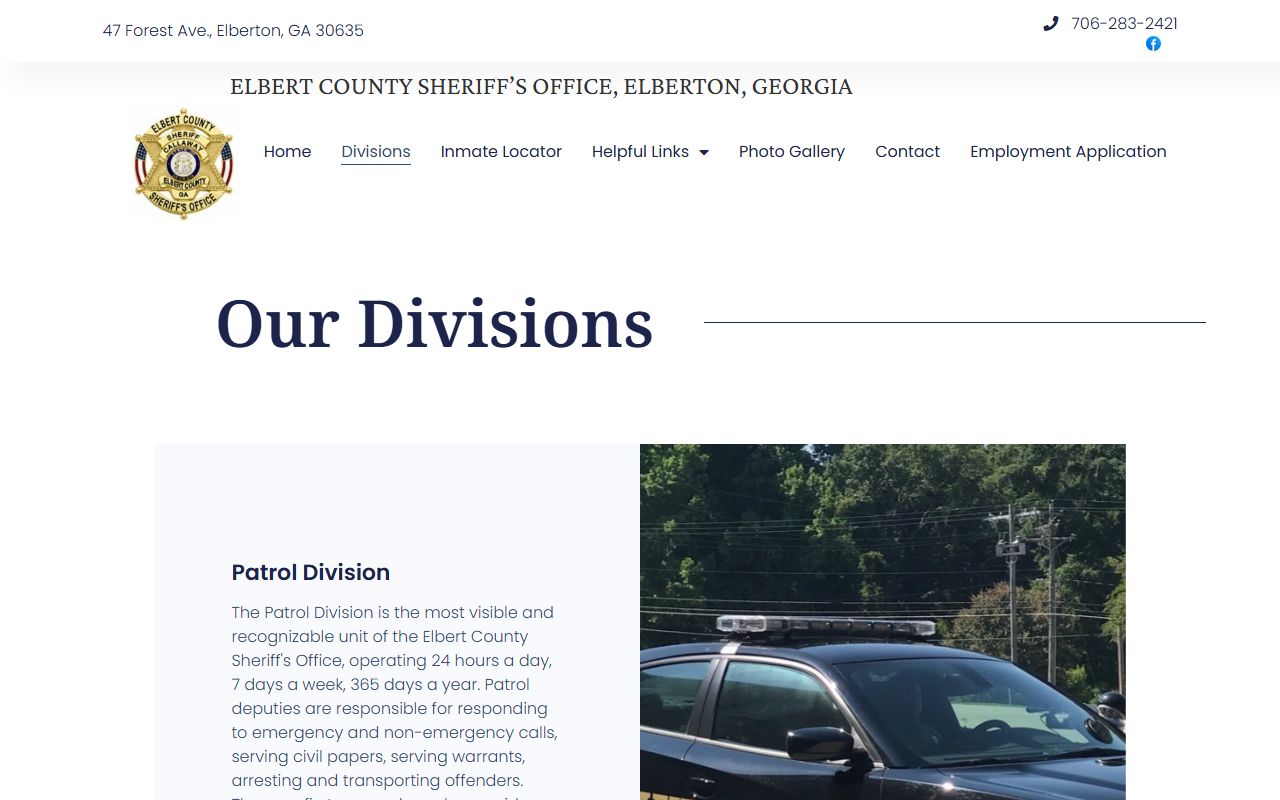
The sheriff divisions page says the Elbert County Detention Center receives and processes people taken into custody. After booking, a person may post cash or property bond and be released pending court, or remain held until disposition. Convicted people sentenced to county or state time may be held locally until the sentence is served or until transfer to a state facility.
Detention Center staff answer phones, greet the public, process bonds, schedule transports to court appearances, arrange medical and dental transports, submit fingerprints, prepare inmate records for court, and schedule inmate and attorney consultations. The public inmate listing research found visible fields such as name, sex, address or state, arrest date and time, and total bond. That is useful for arrest records, but it is not the same as the full court file.
The sheriff divisions page describes how the Detention Center processes arrests, bonds, inmate records, and court transports.
Elbert County Charge Access
Georgia public-access law supports inspection of nonexempt public records, but criminal charges often cross office lines. O.C.G.A. 50-18-70 treats public records as available unless a law or court order limits access. O.C.G.A. 50-18-71 allows agencies to charge lawful search, retrieval, redaction, and copy fees. Uniform Superior Court Rule 21 says Georgia court records are public unless access is limited by law or by the rule's sealing process.
For Elbert County, that means the request should match the record. Ask the sheriff for booking, law-enforcement, and detention material. Ask the Clerk of Court for Superior, State, or Juvenile Court filings and certified dispositions. Ask Magistrate Court about warrants, first appearances, and preliminary criminal functions. Ask Elberton Municipal Court about city traffic or ordinance citations and related bench warrants.
Restricted Elbert County Charges
Not every arrest or charge detail is open to broad public view. Juvenile records have separate access rules. Adoption and mental-health matters are restricted in different ways. Court files can be sealed under Rule 21 or another law. Personal information such as Social Security numbers, financial account numbers, minor names, some addresses, protected victim information, and medical details may be redacted.
| Access Limit | What It Does | Important Caution |
|---|---|---|
| Record restriction | Limits eligible criminal-history information for non-criminal-justice purposes under O.C.G.A. 35-3-37. | Georgia often uses "record restriction" rather than "expungement." |
| Sealed court file | Limits access to a court file or document by rule, statute, or court order. | A public docket may show little or no detail. |
| Juvenile confidentiality | Limits public access to juvenile hearings, records, and files. | Parties, attorneys, agencies, and court-authorized persons may have different access. |
For arrests after July 1, 2013, GBI guidance says eligible restriction is handled through the prosecutor rather than an arresting-agency application. For arrests before that date, the person applies at the arresting agency. Restricting a Georgia criminal-history report does not automatically erase every court docket, jail booking record, news item, or driver-history consequence.
Note: A dismissal on one charge does not prove that all counts from the same arrest were dismissed.
Background Check Limits
Arrest records and court charge records should be read with care in any background-check context. A booking field may show that a person entered custody. A charge field may show that the State accused the person of an offense. Only the disposition or sentence shows how that count ended. For employment, housing, credit, insurance, or other regulated screening, use legally compliant sources and verify final court outcomes.
Important: Do not treat an Elbert County arrest record as proof of conviction without checking the certified court disposition.